A one-line post worth stopping on
Dan Lorenc of Chainguard said today on LinkedIn:
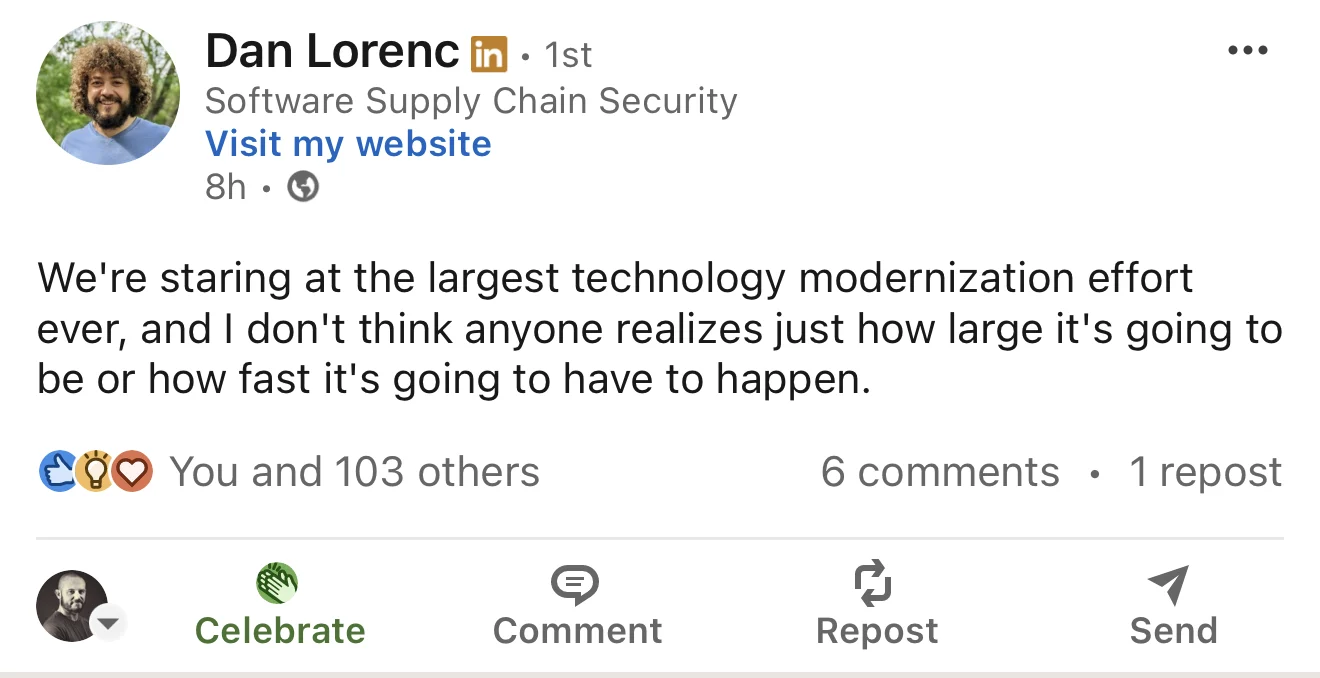
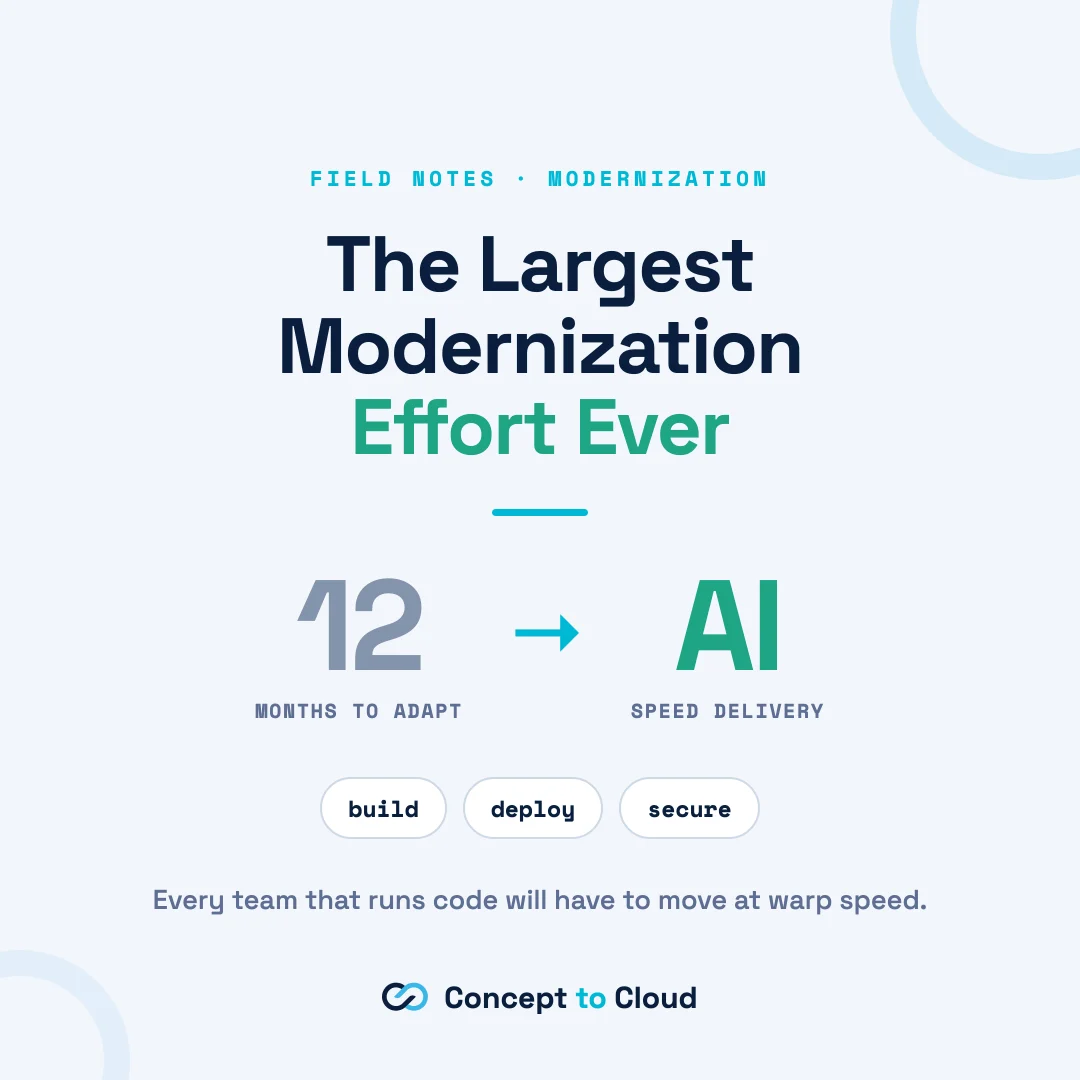
“We’re staring at the largest technology modernization effort ever, and I don’t think anyone realizes just how large it’s going to be or how fast it’s going to have to happen.”
I think this is important, because so many organizations that we work with are still working with traditional methods and operations, especially when it comes to IT modernization and the services that run within the platform. At this point we’re not necessarily talking about cloud infrastructure yet. It’s how you go about building, deploying, and servicing the code and the external applications that you run within your firewall.
The ground has already moved
Over time this has changed dramatically. But with the world of AI now upon us, the way we manage these platforms, the way we build them, and especially the way we secure them is more critical than ever. So much of the world is looking on without realizing quite what an impact this is about to have on us, on our daily lives, and on how we go forward in an industry that’s already changed so much in the last 12 to 18 months. I saw it first hand when I rebuilt Saiku with AI agents this year.
Over the course of the next year, things will change a lot in terms of:
- the rapid evolution of platforms
- the way that people access the data
- the things that people want to do with the data to reach a new level of interactivity, both from an end-user perspective and from a compute execution perspective
Secure is one thing. Keeping up is another.
As we look into the future, data security is obviously paramount for businesses and organizations. This is also why modernization matters so much: it decides their ability to execute and stay secure in an ever-changing, AI-driven environment. (It’s the same reason we spend so much time on hardened, zero-CVE base images.)
Of course, being secure is one thing. Being able to deal with the bottleneck of a backlog of pull requests, code reviews, and the sheer volume of things moving through the pipes is also critical.
Projects like Hive Commons, which has just been accepted into the CNCF, are going to be super important here. They allow for better guardrails and automation, and they reduce the amount of code and interaction a developer actually has to have inside their environment. As we migrate to a ticket-driven and spec-driven development cycle, Hive and the other projects of a similar nature will let businesses commit code, validate that code, sign it off, and get it into production with almost no human contact.
That still leaves people to work through the operational backlog.
Fewer hands on the keyboard, more people who understand the machine
Of course, this creates the need for more product managers and product engineers who understand how these things work from a development perspective. As we move, organizations will change, the way people think will change, and this will take us to a far more automated environment. (The gap it exposes is rarely in code production; it’s in engineering leadership.) The velocity just gets quicker and quicker as fewer people touch the keyboard and more computers write the code.
Get a modernization roadmap in place
Looking through the next 12 months, make sure your organization has a modernization roadmap and understands the challenges that lie ahead, and how you’re going to adapt and evolve to meet them.
A number of organizations are, of course, at the forefront of this. But everybody who consumes code, runs programs, or operates systems will need to move at warp speed, along with the rest of the development cycle, to keep up with the rate at which IT is moving.
Where to start
If you’re not sure where your build, deploy and security practices stand against what’s coming, that’s the first thing to find out. Our Full Technical Assessment reviews the whole estate and hands you a modernization roadmap you can act on. If you’d rather start with a conversation, talk to us. We’ll tell you honestly where you are and what to tackle first.
Ex-NASA engineer and cloud architect with over a decade of experience building scalable systems for startups and enterprises.
Work with Tom →