
Some software you build never quite leaves you. Saiku is mine.
For close to a decade I ran Saiku, a commercial open source OLAP tool that lived alongside, and sometimes inside, the Pentaho BI platform. It let business users do drag-and-drop analysis of their data in an era when that kind of self-serve analytics either didn’t happen at all or happened exclusively inside expensive proprietary suites. We had real users. Amazon, Samsung, financial institutions, government departments, they all leaned on it. What we didn’t have, in any meaningful quantity, were contributors. Or paying customers willing to fund continued development.
After years of running close to broke, I gave up and went to work for NASA, much to the chagrin of the users still relying on the platform. There’s a particular kind of irony in being criticised for failing to support software that no one else was willing to fund either, but that’s the open source story in a nutshell.
A Few Hours of Idle Curiosity
Fast forward to 2026, the year of the agentic AI agent, and I found myself wondering whether the old codebase would even compile. So I pointed Claude at it and asked it to get the legacy version running.
Thirty minutes later, I had a working build on my Mac.
That was the moment the curiosity tipped over into something more deliberate. I asked the agent to update the major dependencies, then to write tests to make sure nothing had silently broken in the process. It did. Everything held together.
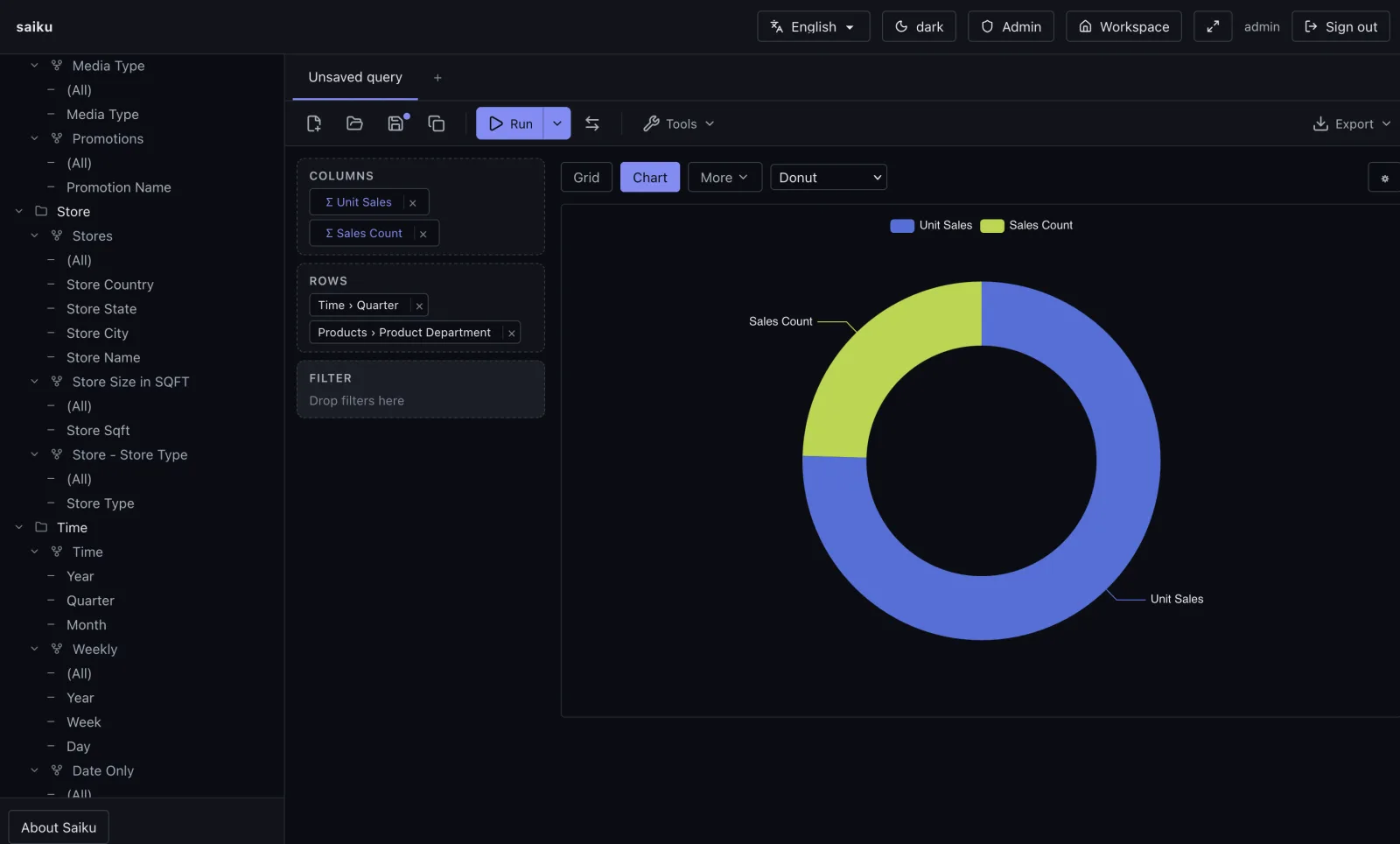
So I pushed further. The UI was functional but visibly dated. Modern web frameworks have come a long way since the original Saiku front-end was built. I asked Claude to rebuild the interface in Svelte, a framework I’m comfortable working in, and a few hours and several rounds of refinement later, Saiku had a modern, responsive UI built on current web technology.
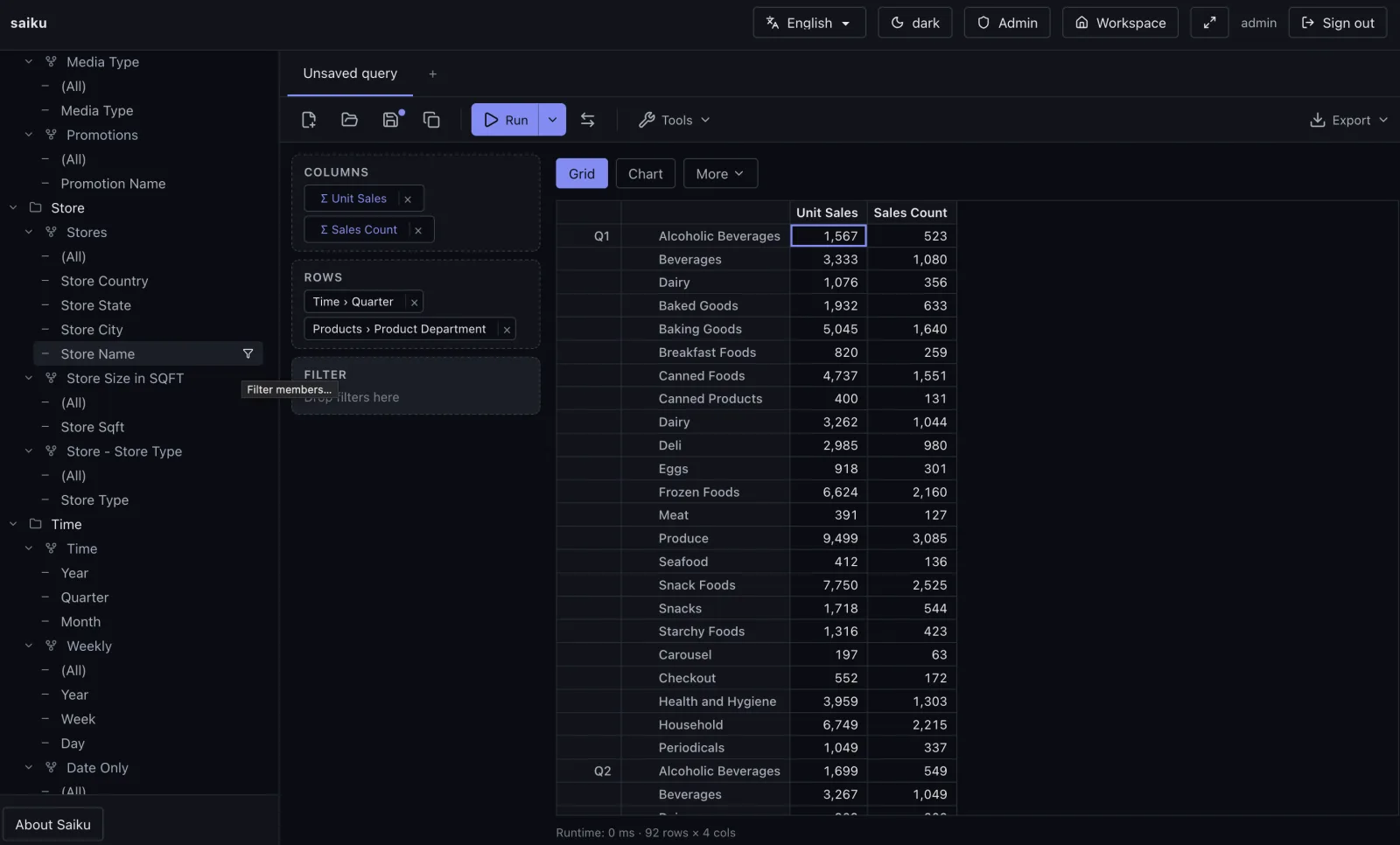
The familiar Saiku interaction model survived the rebuild intact, drag dimensions onto rows, measures onto columns, hit run, but everything around it is new: a current component library, dark mode out of the box, a faster render path, and a layout that holds together on smaller screens. Switching from grid to chart is the same single click it always was.
Going Deep on the Engine
The natural next step was to look at Mondrian, the OLAP engine that powers Saiku’s query layer. We use version 4, which has a story of its own, but the SQL generation layer had aged badly: thirty-odd dialect classes hand-coded across two decades, with limited support for the modern analytical databases people actually deploy today.
So we replaced it. Apache Calcite sits inside the query path now, generating SQL across forty-plus dialects out of the box, with automatic aggregate-table rewriting that turns ten-second fact-table scans into one-second pre-aggregate hits. I wrote up the technical detail separately, the headline numbers are real, but the lessons buried in the work are more interesting than the benchmarks.
Releasing It
Which brings me to now. I have a couple of weeks of vacation, which, as anyone who ships software knows, really means time to finish what I started. The build works. The tests pass. The majority of the surface area behaves the way you’d expect. It’s not exhaustively production-hardened yet, but it’s real and it runs, and that’s enough to release.
There’s more I want to do. Building OLAP cubes from raw schemas is still more tedious than it ought to be, and I’ve started prototyping AI-assisted cube generation to address that. The wider angle, exposing the semantic layer to AI agents so they get reliable numbers instead of hallucinated column names, is covered in our semantic layer for AI agents via MCP writeup. There’s another wave of improvement to come, some of it AI-driven, some of it just better tooling and broader database support.
Does OLAP Still Matter in 2026?
That’s the genuine open question. The analytics landscape has fragmented since Saiku’s heyday. Modern warehouses are fast. Semantic layers have moved into BI tools that didn’t exist when Saiku launched. Whether multi-dimensional analysis as a discrete product category still has room to breathe is something the market will decide, not me.
What I do know is that this piece of software launched my career and helped get me to where I am today. Having got this far on a couple of weeks of agentic exploration, releasing it back into the world feels like the right thing to do, both as a quiet thank-you to a project that gave me a lot, and as a marker for what is now possible when you point a capable AI agent at a codebase you’d long since stopped touching.
The code is open and the project home is at saiku.bi. The UI is modern. The engine is faster. If you’ve got a use case for it, take it for a spin, see the rest of our studio, or browse more of what we’ve built.
If you’re considering reviving a legacy codebase with AI agents, or want to talk about AI-driven engineering work more generally, drop me a line. The pattern that worked here, small, well-scoped prompts against a well-tested core, is more transferable than the specific project.
Ex-NASA engineer and cloud architect with over a decade of experience building scalable systems for startups and enterprises.
Work with Tom →