
Big, well attended, informative, and underwhelming
I spent a couple of days at the AWS Summit in Washington, DC, this week. It was big, well attended, and informative. It was also, and I say this as someone who genuinely enjoys this stuff, a little underwhelming.
As you’d imagine, nearly every talk had some LLM angle: how we did this, how we did that. Some were interesting, others less so, but they all shared the same vibe. Then I spent a good while crawling the vendor booths, which were a mixed bag. I found myself quietly appreciating the vendors who hadn’t skewed everything they’d traditionally done to wrap it in an AI framework. So many stands read “We’ll help you do AI” or “We’ll help you do X, with AI” that it got stale fast.
The kit that actually impressed
Don’t get me wrong, there were some amazing bits of kit. AWS Outpost racks. Some really superb miltech from Anduril, their Voyager kit and their large containerised data centres were genuinely cool. Hardware you can walk up to and poke at, doing something specific and doing it well.
But so many of the incumbent software providers were shilling the same thing they always have, now with an AI tag stapled on the side. And that’s the sad part. In the rush to market, innovation seems to have decreased, mostly, I think, out of FOMO.
I’ve said this a few times recently and I’ll keep saying it: it’s not the vendors with AI enablement that will win. It’s the ones doing genuinely novel things that will cut through the noise and come out the other side. An LLM hooked onto the edge of last year’s product to speed up one small step is not a strategy. It’s a feature flag with better marketing. (Not all AI is created equal, and the market is about to start telling the difference.)
It’s not the model, it’s what you put around it
We’re seeing the same pattern across engineering software right now. The model itself is becoming less and less the differentiator. What matters is what you build around the model.
And we’re iterating so fast that keeping up, and keeping your engineers up to speed, is a genuinely hard ask. Look at how quickly people have moved from Claude Code to Codex to Cursor to Kiro. Nothing stands still for long. So walking the AWS floor and seeing companies offering not much more than they did last year, with an LLM bolted on to accelerate one aspect of the job, just wasn’t that impressive.
The teams that win the next couple of years won’t be the ones with the newest model. They’ll be the ones who’ve done the harder, less glamorous work of building something defensible around it.
The interesting conversations were off to one side
That said, there were plenty of data providers there, companies focused on what actually underlies the LLMs. Because when you’re working with internal data, the model’s responses are only ever as good as the data you feed it. That’s not a slogan; it’s the whole ballgame. It’s the same point I keep coming back to: your AI project is usually a data project wearing a nicer jacket.
Some of the best chats I had were with companies quietly doing interesting things at the edges of the hall. How Snyk is working to detect the newer classes of threat we’re seeing. How Chainguard is working to secure the supply chain as attacks on the open-source ecosystem, CI pipelines, and other soft targets get more frequent. Because at the end of the day, if you can get into multiple businesses through a single poisoned dependency, that’s an easy way in.
And this is the bit that should worry more people: with LLMs generating code at speed, the bottleneck is no longer the coding. It’s the review, the sign-off, and the deployment. Which means, in the mad rush to become the next “Agentic AI-enabled company,” less attention is being paid to the software going out the door. That’s a security problem dressed up as a productivity win, and we’ve already seen the first AI-orchestrated cyberattack to prove the point.
The talks worth the seat
I mentioned the talks up top, and a few genuinely stood out.
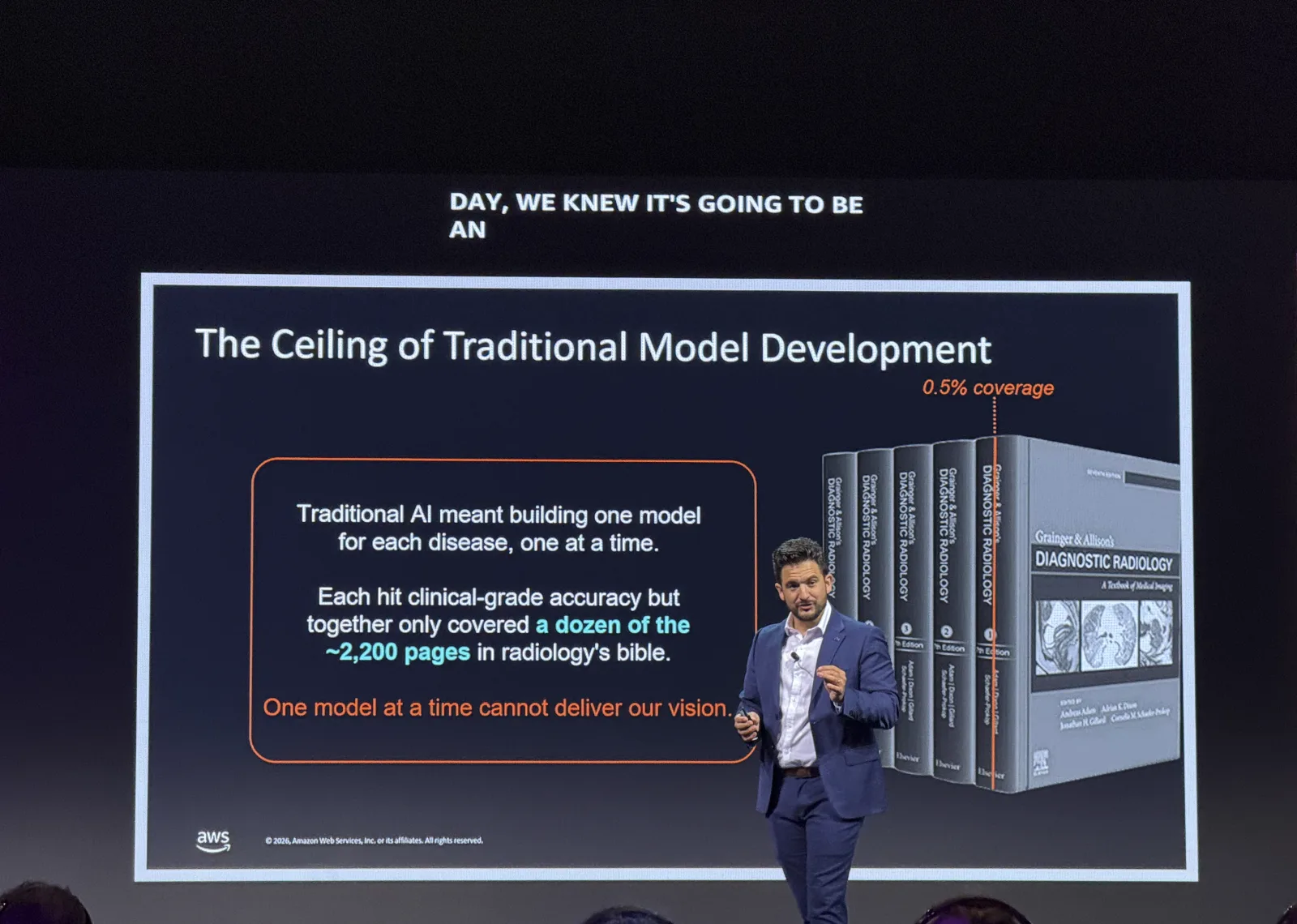
Aidoc’s session on how they trained their own model was excellent, specific, honest, and technical enough to be useful.
Nick from First Street gave a great talk on modelling climate risk accurately alongside business locations. It sadly glossed over some of the nerdier mechanics in favour of how the AWS AI Office helped them as an extension of their team, great for the business folks in the room, a little less so for me.
And in the age of modern warfare, hearing how DARPA and various universities are deploying edge computing to support drone and autonomous robotics programs was fascinating. That one leaned into the facts of the program, how they actually pulled it off, and the wins that came out of it, which is exactly the level I wanted more of.
The takeaway: it’s still the data
All in all, a mixed bag. I didn’t go to DC needing to learn a pile of new technical material, but I did expect to come away knowing more about what AWS is actually offering, and I felt some of that got lost in the noise. They showcased some genuinely interesting use cases, but they could have gone a notch more technical. Some of what was on display looks like magic until you remember what’s underneath it.
Because it never is magic. As ever, it’s the data. The winners won’t be the loudest AI logo on the stand. They’ll be the teams doing something novel, on top of data they’ve actually done the work to get right.
If that’s the work in front of you, getting the data underneath your AI ambitions into a state that can actually carry them, that’s exactly the unglamorous problem we help with.
Ex-NASA engineer and cloud architect with over a decade of experience building scalable systems for startups and enterprises.
Work with Tom →