

Updated May 2026. Since the original November 2025 piece, two things have made the orbital data center thesis far more concrete: SpaceX has filed with the FCC to deploy one million satellites for orbital AI compute, and SpaceX has acquired xAI in a $1.25 trillion deal that funds the buildout. The Starlink V3 platform that this article describes is now the substrate beneath those plans rather than a speculative one, everything below reflects that.
The Race to Space-Based Computing
What began as a Musk Twitter remark about “simply scaling up Starlink V3” has, eighteen months on, turned into the most ambitious infrastructure programme since the original AWS buildout. SpaceX is taking its next-generation Starlink V3 satellites, terabit-class hardware originally pitched as a broadband upgrade, and repositioning them as the physical layer of a global orbital data center network. The FCC application, the xAI merger, and Starship’s flight cadence in early 2026 turn what was a thought experiment into an actual capital-allocation question for cloud buyers.
Technical Foundation: Starlink V3 Capabilities
Current Starlink V2 mini satellites max out around 100 Gbps capacity. The upcoming V3 generation represents a tenfold leap, delivering up to 1 Tbps (terabit per second) per unit. These satellites feature high-speed laser links enabling direct satellite-to-satellite communication without ground stations, creating a mesh network in orbit capable of processing and routing data entirely above Earth’s atmosphere.
SpaceX aims to launch 60 high-capacity Starlink V3 satellites per Starship flight starting in 2026. The reusable Starship launch system dramatically reduces deployment costs compared to traditional rockets, making large-scale orbital infrastructure economically viable.
Musk’s Vision for Orbital Computing
“Simply scaling up Starlink V3 satellites, which have high-speed laser links, would work. SpaceX will be doing this,” Musk stated in response to discussions about orbital data centers. This confirmation aligns with growing interest from tech leaders in relocating data infrastructure beyond Earth’s surface.
The concept builds on Starlink’s existing architecture rather than requiring entirely new technology. By enhancing satellite processing capabilities and storage while maintaining the laser-linked mesh network, SpaceX can transform communications satellites into distributed computing nodes.
Industry Context: A Billionaire Space Race
Musk’s announcement follows similar statements from other tech industry leaders:
Jeff Bezos predicted “there will be gigawatt data centers in space in 10+ years” during a recent technology conference, referencing Blue Origin’s capabilities.
Eric Schmidt, former Google CEO, revealed he acquired rocket company Relativity Space specifically to pursue orbital data center deployment, calling it “the logical next step” for cloud infrastructure.
This emerging competition mirrors the early cloud computing race when Amazon, Microsoft, and Google rushed to build massive terrestrial data center networks. The stakes are potentially higher this time, with first-movers gaining strategic advantages in space-based computing infrastructure.
The Orbital Advantage: Benefits and Challenges
Potential Benefits
Unlimited Solar Energy: Space-based facilities access continuous, unfiltered sunlight without weather interference or nighttime interruptions. Solar panels operate at maximum efficiency, eliminating electricity costs and carbon emissions associated with terrestrial data centers.
No Land Use Conflicts: Orbital infrastructure eliminates the real estate, zoning, and environmental concerns plaguing ground-based facilities. No communities are disrupted, no ecosystems destroyed, and no water resources consumed for cooling.
Reduced Latency for Global Services: Data traveling through the satellite mesh network can take more direct routes than undersea cables or terrestrial fiber, potentially reducing latency for intercontinental communication. For modern cloud-first architectures, this could enable truly global services with consistent performance.
Natural Cooling: The vacuum of space provides excellent thermal management through radiative cooling, eliminating the massive energy expenditure required for terrestrial data center air conditioning.
Technical Hurdles
Launch Costs: Despite SpaceX’s reusable rockets, deploying significant computing infrastructure to orbit remains expensive. Each kilogram launched costs substantially more than ground-based equipment.
Maintenance and Upgrades: Repairing or upgrading orbital hardware presents challenges absent in terrestrial facilities. While Starship promises to make servicing missions more routine, the logistics remain complex compared to walking into a data center with replacement hardware.
Radiation Hardening: Space electronics require extensive shielding and redundancy to withstand cosmic radiation and solar events. This adds weight, complexity, and cost compared to ground-based systems.
Heat Dissipation: While space offers cooling advantages, actually radiating heat away from densely packed computing hardware in a vacuum presents engineering challenges. Traditional fans and liquid cooling won’t work in space.
Orbital Debris: Adding large computing platforms to Earth’s orbit contributes to the growing space debris problem. Collisions or end-of-life disposal must be carefully managed to avoid creating hazardous fragments.
Market Implications
The emergence of orbital computing infrastructure could reshape the cloud services market. Current providers like AWS, Azure, and Google Cloud have invested billions in terrestrial data centers strategically positioned near major internet exchanges and population centers. Space-based alternatives could disrupt these carefully constructed networks.
Organizations leveraging multi-cloud strategies might soon evaluate orbital providers alongside traditional options. Workloads particularly sensitive to latency, requiring global distribution, or facing strict sustainability requirements could become early adopters of space-based computing.
The technology also has implications for edge computing architectures. Rather than deploying infrastructure to countless locations worldwide, organizations might route traffic through orbital nodes positioned optimally for global coverage.
Regulatory and Security Considerations
International space law, particularly the Outer Space Treaty of 1967, establishes principles for space activities but predates commercial space infrastructure. As orbital data centers become reality, governments and international bodies will need to address:
Data Sovereignty: If data resides in orbit, which nation’s laws apply? This question becomes particularly complex when satellites pass over multiple countries throughout their orbits.
Security and Encryption: Cloud security takes on new dimensions when infrastructure exists beyond traditional national boundaries. Physical security of orbital assets requires different approaches than terrestrial facilities.
Spectrum Allocation: Massive orbital computing platforms will require significant radio spectrum for ground communication. International coordination through bodies like the ITU becomes critical.
Environmental Impact Assessments: While avoiding ground-based environmental concerns, orbital infrastructure introduces new considerations around space sustainability and light pollution affecting astronomical observations.
Timeline and Next Steps
As of mid-2026, the timeline has moved out of the slide deck and into the regulatory record. The FCC filing requests deployment of up to one million satellites between 500km and 2,000km altitude, organised into clusters approximately 50km apart to serve different latency profiles. SpaceX’s own messaging now puts cost-competitiveness with terrestrial data centers within two to three years, aggressive, but the financing question that hung over the November 2025 announcement has been answered by the xAI merger.
A realistic phasing:
- Initial Starlink V3 + pilot compute payloads (2026): Operational Starship launches scaling V3 broadband first, with early compute payloads riding the same constellation.
- AI inference workloads on early clusters (2027-2028): The FCC filing explicitly targets inference, not training, the first orbital “AZ” likely serves inference for enterprise customers.
- Regulatory framework catches up (2026-2029): Spectrum coordination, data sovereignty, and orbital debris policy lag the technology; expect this to be the rate-limiter, not the engineering.
- General-availability orbital compute (2028-2030): A mainstream public-cloud SKU for orbital inference, sold alongside terrestrial regions.
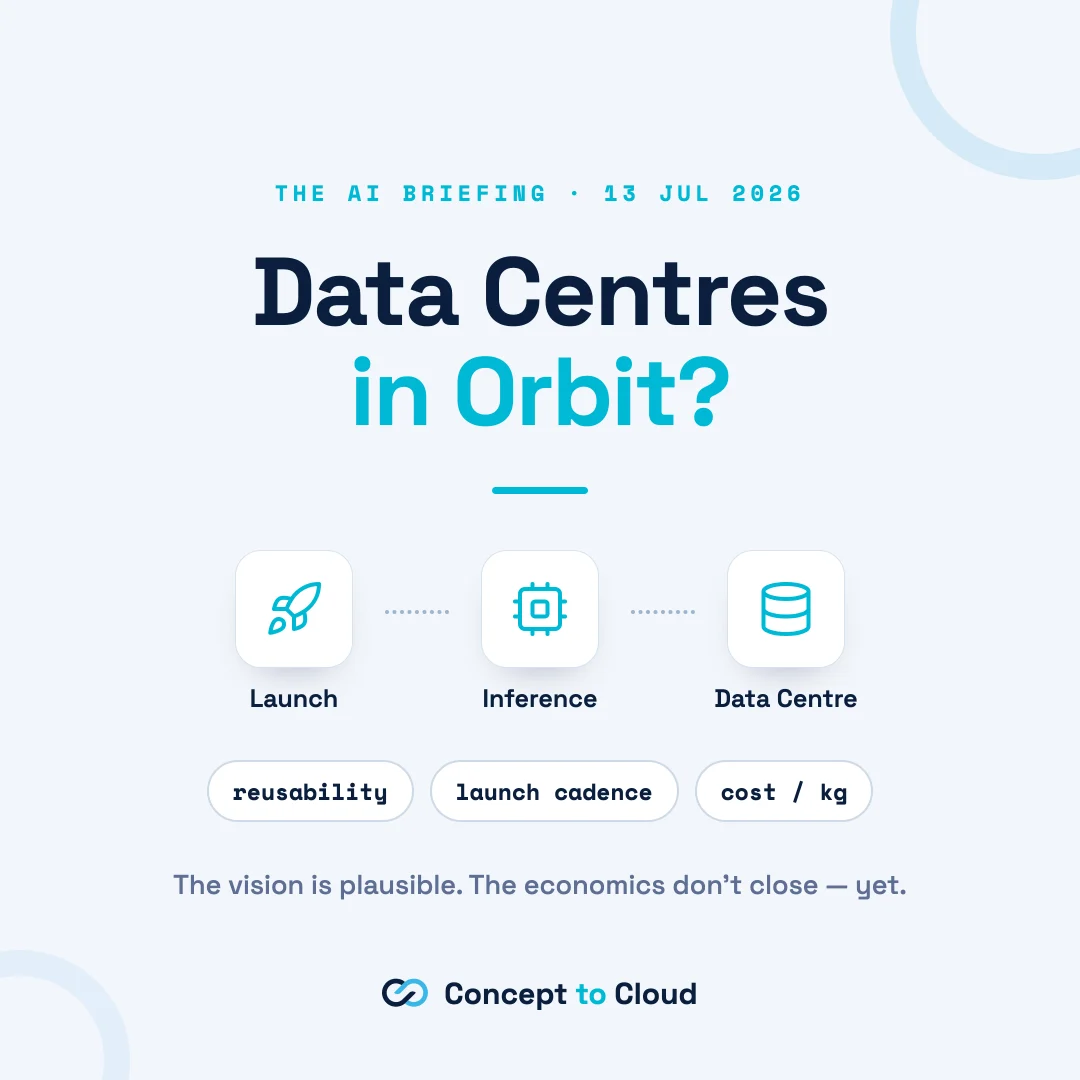
Two failure modes still gate the whole thesis. Starship needs to hit its per-kg launch cost targets, without that, the economics collapse and the constellation never reaches scale. And a five-year satellite lifespan against a million-unit fleet implies replacing ~550 satellites per day at steady state, a logistics problem with no precedent. Neither is settled.
For now, the practical question for cloud buyers is no longer “is this real?”, it’s “which workloads should I architect to be portable to a non-terrestrial inference tier within five years?”
Looking Forward: A New Computing Frontier
Orbital data centers represent more than a novel deployment model, they fundamentally reimagine where computing infrastructure can exist. Just as cloud computing freed organizations from managing physical servers, space-based infrastructure could eliminate constraints imposed by Earth’s surface.
The success of these ventures depends on overcoming substantial technical, economic, and regulatory challenges. However, with multiple well-funded competitors pursuing similar visions, space-based computing appears poised to transition from science fiction to business reality.
For organizations planning cloud migration strategies or evaluating future infrastructure needs, monitoring developments in orbital computing makes sense. While traditional cloud providers will remain dominant for the foreseeable future, understanding emerging alternatives prepares businesses for a landscape where computing infrastructure literally reaches for the stars.
As Musk and his peers demonstrate, the next frontier in cloud computing may not be the next availability zone, it might be the next orbit.
Ex-NASA engineer and cloud architect with over a decade of experience building scalable systems for startups and enterprises.
Work with Tom →