

The Merger That Changes the Compute Landscape
SpaceX has officially acquired xAI in a deal valuing the combined entity at $1.25 trillion, making it the world’s most valuable private company. But the headline number isn’t the story. The story is what Musk plans to do with it: launch one million satellites to create orbital AI data centers.
This isn’t science fiction. SpaceX has already filed with the FCC for permission to deploy the constellation. The satellites would operate between 500km and 2,000km altitude, functioning as distributed processing nodes optimized for large-scale AI inference. We first covered SpaceX’s orbital data center ambitions back in November 2025, but this merger accelerates everything.
Musk’s thesis is straightforward: global electricity demand for AI cannot be met with terrestrial solutions. Ground-based data centers face grid limitations, cooling constraints, and community resistance. Space offers unlimited solar energy and radiative cooling, no electricity bills, no water consumption, no NIMBY battles.
His timeline? Cost-competitive with ground facilities within two to three years.
The Systems Engineering Reality
Let’s set aside the hype and look at what this actually requires from an architecture perspective.
The latency problem is real but solvable. Satellites at 500km altitude add roughly 3-4ms round-trip latency compared to a local data center. For inference workloads, running trained models against new data, that’s acceptable for most applications. Training workloads are a different story, but the FCC filing specifically targets inference.
The constellation architecture mirrors terrestrial distributed systems. SpaceX describes clusters operating at 50km intervals, “geared towards different workload and latency demands.” This is essentially availability zones in orbit. The same principles that govern multi-region deployments apply: data locality, eventual consistency, partition tolerance.
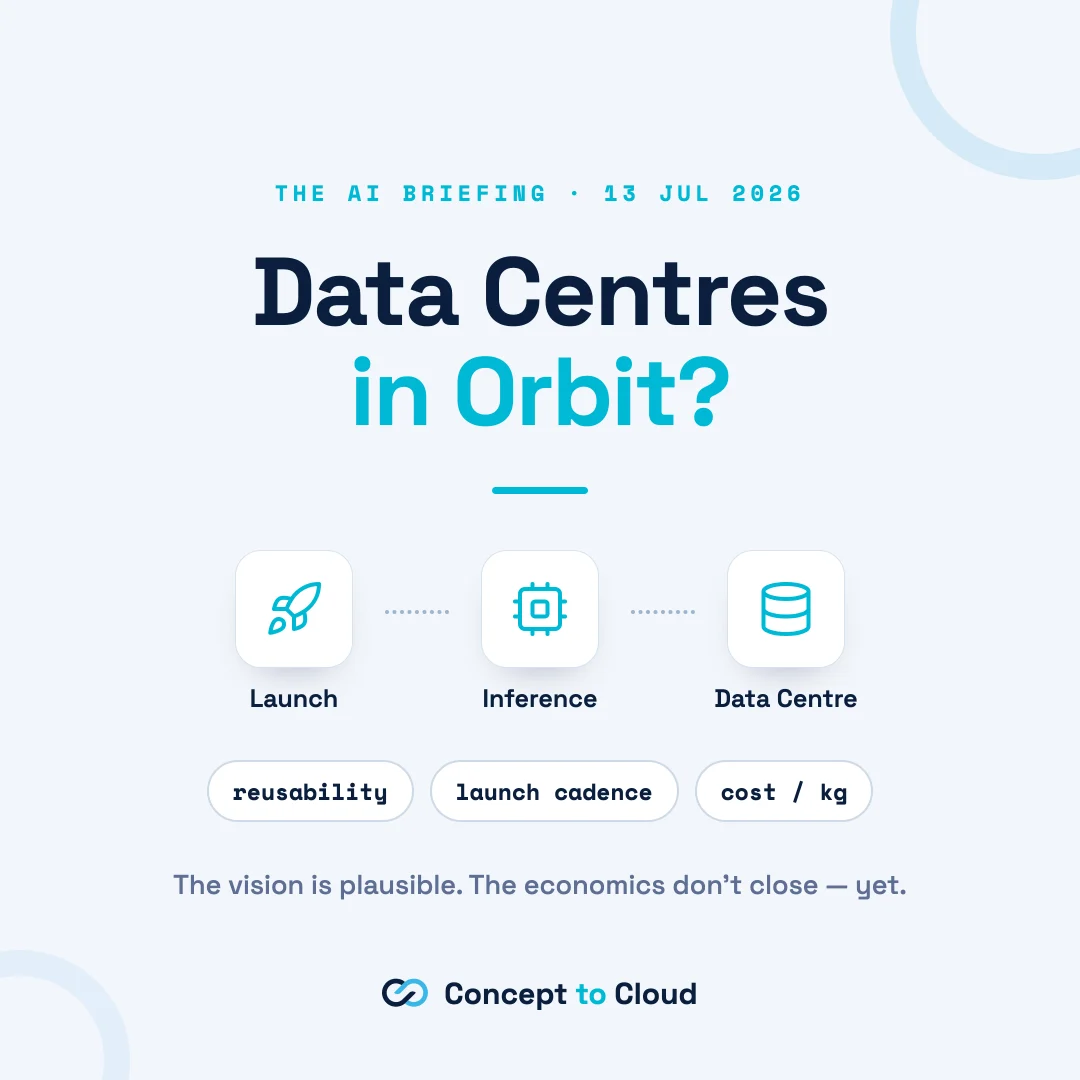
Starship is the bottleneck. The entire economic model depends on Starship’s radical cost reduction, launching millions of tonnes annually at costs that make orbital compute cheaper than terrestrial. After 11 test flights, operational payloads are expected this year. Miss that timeline and the economics collapse.
Five-year satellite lifespan means constant replacement. A million satellites with five-year operational lives means replacing 200,000 satellites annually just to maintain capacity. That’s roughly 550 satellites per day. The logistics are staggering, but so was the idea of 9,000 Starlink satellites five years ago.
What This Means for Cloud Architecture Decisions Today
If you’re designing systems now, you’re not designing for orbital data centers. But you should be designing for a world where compute economics shift dramatically.
Inference-heavy architectures become more viable. If Musk’s timeline holds, running large model inference could become radically cheaper within 3-5 years. Systems designed today should consider how they’d leverage abundant, cheap inference capacity. That means clean separation between training and inference workloads, APIs that can route inference requests to different backends, and architectures that don’t assume inference is the expensive part.
Edge computing gets more interesting. Orbital data centers are essentially edge nodes with global coverage. The same architectural patterns, local processing, intermittent connectivity, eventual consistency, apply. If you’re building IoT systems or distributed sensor networks, the skills transfer directly.
Multi-cloud becomes multi-orbit. Today’s cloud-agnostic architectures prepare you for tomorrow’s compute diversity. Systems that abstract away infrastructure specifics, whether that’s AWS vs. GCP or ground vs. orbital, will adapt more easily.
The Tesla Factor
This merger doesn’t happen in isolation. Tesla just announced it’s ending Model S and X production to convert Fremont factory lines for Optimus robot manufacturing. The company reported its first-ever annual revenue decline in 2025, down to $94.8 billion with net income plummeting 46%.
Musk is explicitly pivoting from vehicles to AI and robotics. The SpaceX-xAI merger, the Optimus push, the orbital data center plans, they’re all pieces of the same strategy: control the infrastructure layer for the AI era.
xAI is currently burning roughly $1 billion per month. SpaceX generated $8 billion profit on $15-16 billion revenue in 2025. The merger gives xAI access to SpaceX’s cash flow and launch capabilities. It gives SpaceX a reason to scale Starship beyond Starlink.
The planned IPO, potentially valuing the combined entity at $1.5 trillion, would fund the orbital data center buildout. It’s vertical integration at planetary scale.
The Competition Is Already Moving
Google announced Project Suncatcher last year, a partnership with Planet to put TPUs in space. They’re still in early test stages, but the thesis is the same: space offers compute resources that Earth can’t match.
This is the new infrastructure race. Not which cloud provider has the best Kubernetes managed service, but who can deploy compute capacity without terrestrial constraints.
What We’re Watching
For our clients in fintech, IoT, and research computing, we’re tracking several implications:
Latency-sensitive workloads need ground truth. Orbital compute works for inference, batch processing, and analytics. It doesn’t work for sub-millisecond trading systems or real-time control loops. Know which category your workloads fall into.
Data gravity still matters. Moving petabytes to orbit has the same physics problem as moving petabytes between cloud regions, it takes time and bandwidth. Systems that minimize data movement will adapt better regardless of where compute lives.
Regulatory complexity increases. Orbital infrastructure crosses every jurisdiction simultaneously. Data sovereignty, export controls, and compliance frameworks weren’t designed for compute that literally orbits the planet. If you’re in regulated industries, start thinking about this now.
The talent pipeline shifts. Systems engineering for orbital infrastructure requires skills that don’t exist in most organizations. The companies that figure out how to architect for space-based compute first will have significant advantages.
The Bottom Line
Musk’s vision might succeed or fail. Starship might hit its cost targets or miss them. The regulatory path might clear or hit obstacles. None of that changes the fundamental insight: terrestrial infrastructure is approaching limits that orbital infrastructure doesn’t have.
Whether SpaceX builds the first orbital data centers or someone else does, the architectural implications are the same. Systems designed for flexible infrastructure deployment, clean workload separation, and graceful handling of variable latency will adapt. Systems tightly coupled to specific infrastructure assumptions won’t.
The cloud is literally moving to the clouds. The question isn’t whether to prepare, it’s how quickly you need to.
We help companies design systems that survive infrastructure transitions, whether that’s cloud migration, platform modernization, or preparing for compute paradigms that don’t exist yet. If you’re thinking about how orbital infrastructure affects your architecture decisions, let’s talk.
Ex-NASA engineer and cloud architect with over a decade of experience building scalable systems for startups and enterprises.
Work with Tom →