
Introduction
Moving workloads to the cloud without strategic planning, via VMs or containers, may not be the most economical approach for MVPs or startups. Success depends on several factors: process customization needs, available cloud vendor solutions, and infrastructure complexity.
Cloud-First Concepts Defined
Cloud-first concepts are the idea that, more often than not, it’s preferable that someone else manage the infrastructure your applications, data flows, storage or whatever depends on. Our team specializes in helping companies adopt cloud-first architectures. Explore our cloud solutions services.
This approach offers multiple advantages:
- Data Center Quality: Cloud providers operate superior facilities with advanced technology
- Cost Efficiency: While per-service fees may appear higher, total cost of ownership decreases significantly when factoring in developer salaries and infrastructure staff ($100k+)
- Operational Focus: Teams concentrate solely on application code, not maintenance or upgrades
- Scalability & Efficiency: Built-in scaling and reliability mechanisms
Traditional Architecture Example
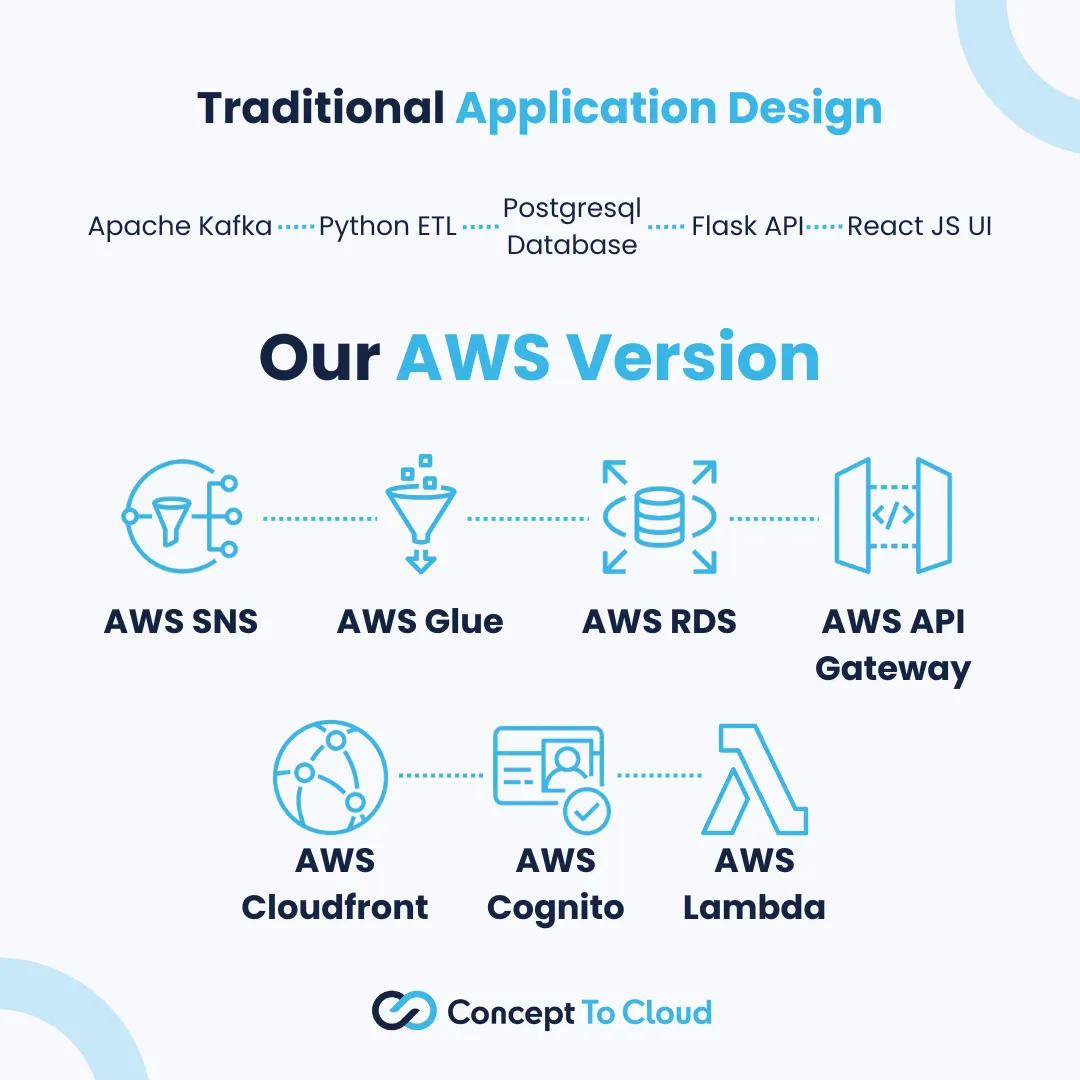
A stock market tracking application with typical components:
Backend: Kafka message queue → Python/Pandas ETL process → PostgreSQL database
Frontend: React UI → Node.js server → Authentication layer
Cloud-First Architecture Redesign
Messaging: AWS Managed Streaming for Kafka (replaces self-hosted Kafka)
ETL Processing: AWS Glue streaming jobs (replaces custom Python containers)
Database: Amazon RDS with serverless options or Redshift (replaces self-managed PostgreSQL)
API Layer: AWS API Gateway with Lambda functions (replaces Flask backend)
Authentication: AWS Cognito (replaces custom auth backend)
Frontend Delivery: AWS CloudFront CDN (replaces server-based hosting)
When Cloud-First Doesn’t Make Sense
While we advocate strongly for cloud-first approaches, honest advice requires acknowledging situations where cloud-native architecture creates unnecessary complexity or expense.
Ultra-low latency trading systems performing microsecond-sensitive operations often require bare-metal hardware and direct network infrastructure control. The additional network hops inherent in cloud architectures can introduce latency that destroys competitive advantage. If you’re building algorithmic trading infrastructure where milliseconds matter, specialized hosting with dedicated hardware might prove necessary.
Extreme data gravity scenarios occasionally favor hybrid approaches. If you’re processing terabytes of data generated by on-premises scientific instruments or manufacturing sensors, the cost and time to transfer that data to cloud storage for processing might exceed the value gained from cloud-based analytics. In these cases, edge computing or on-premises processing with cloud-based aggregation and long-term storage often makes more sense.
Regulatory constraints in specific industries sometimes mandate data remain within facilities you physically control. While most regulations actually permit cloud usage with proper controls, certain government contracts or financial institutions maintain stricter interpretations. Understand your actual requirements rather than assumed limitations, we’ve helped clients navigate regulatory frameworks that seemed prohibitive but actually offered flexibility. Learn more about navigating these decisions in our essential guide to cloud migration.
Very small, stable workloads with predictable usage occasionally cost less on traditional hosting. If you’re running a simple website for a small business with stable traffic patterns and no plans for expansion, a $20/month shared hosting plan might serve better than cloud infrastructure that costs $50-100 monthly. Cloud’s value proposition grows with scale, complexity, and variability, for the simplest cases, it can represent over-engineering.
That said, most startups benefit dramatically from cloud-first thinking. The scenarios above represent exceptions, not rules. If you’re uncertain whether your use case fits these exceptions, it probably doesn’t, the scalability, managed services, and operational benefits typically outweigh the edge cases where traditional infrastructure makes sense.
Key Takeaways
- Deconstruct applications into component parts to identify cloud service equivalents
- Security advantages: Managed services handle patching automatically; self-hosted solutions require manual maintenance
- Scalability benefits: Cloud services handle failover, upgrades, and load distribution
- Developer alignment: Design deployment targets early to prevent costly rewrites
- Lean operations: Small teams (under 10 members) can build scalable systems with minimal support overhead
The Total Cost of Ownership Reality Check
Founders often compare cloud service pricing directly against traditional hosting costs and conclude cloud expenses seem high. This comparison misses the complete picture of total cost of ownership.
Consider our stock market tracking application example. Hosting Kafka on a virtual machine might cost $40 monthly compared to $200 monthly for AWS Managed Streaming for Kafka. That 5x cost difference seems significant until you account for the full operational reality.
Self-hosted Kafka requires ongoing maintenance: monitoring cluster health, applying security patches, configuring backup systems, testing disaster recovery procedures, and troubleshooting failures. For a team with existing Kafka expertise, this might require 4-6 hours monthly. At a loaded developer cost of $100,000 annually (roughly $60/hour), that’s $240-360 monthly in maintenance overhead. The “cheaper” self-hosted option now costs more than the managed service before considering the opportunity cost, those 4-6 hours could have been spent building features that differentiate your product.
The calculation shifts further when you factor in growth scenarios. Scaling self-hosted Kafka from three to nine nodes for increased throughput requires significant engineering work: capacity planning, cluster reconfiguration, data rebalancing, and testing. This might represent 20-30 hours of work. With managed services, you adjust a configuration parameter and let AWS handle the complexity. For startups trying to capture market opportunities, the ability to scale quickly often determines success or failure.
The hidden costs of self-management extend beyond direct labor. When your self-hosted database fails at midnight, someone gets paged. When a security vulnerability is disclosed, someone must evaluate and patch systems within days. When your CTO leaves for another opportunity, institutional knowledge about your custom infrastructure leaves with them. Managed services include 24/7 monitoring, automatic patching, and expertise that doesn’t resign.
For small teams building products, the calculus is clear: every hour spent on infrastructure maintenance represents an hour not spent talking to customers, refining your product, or building competitive advantages. Cloud-first concepts enable lean teams to operate like much larger organizations by letting specialized teams at AWS, Google, and Microsoft handle the operational complexity of infrastructure.
The investment in managed services buys you time and focus, startup’s most precious resources. Consider this when evaluating costs: are you optimizing for the lowest possible infrastructure bill, or the fastest path to product-market fit?
Conclusion
Cloud-first thinking isn’t purely about cost reduction, it’s about leveraging specialized managed services to build efficient, scalable applications with limited staff. For startups building their first cloud applications, check out our cloud stack decisions for early-stage startups. You can build a billion-dollar company with less than ten members of staff and superb execution on all fronts.
Ex-NASA engineer and cloud architect with over a decade of experience building scalable systems for startups and enterprises.
Work with Tom →