
Introduction
Cloud computing fundamentally changes how researchers collaborate. Historically, researchers operated in siloed environments where sharing and collaborating in anything close to real time proved difficult. Remote work often limited data exchange to notebooks or spreadsheets until publication.
Modern technology enables optimized global data sharing through affordable object storage and scalable compute resources, whether serverless or on-demand. Researchers working on modest budgets can now collaborate globally through these combined capabilities.
Understanding Cloud Research Fundamentals
Computing collaboration evolved dramatically from ARPANET’s 1969 inception through the World Wide Web’s 1991 launch. Today, distributed researchers tackle global challenges requiring coordinated efforts across continents.
Despite technological advances, researchers frequently maintain antiquated workflows. Data scientists rely on notebook environments (SQL interfaces, Spark servers, Pandas) or Excel for data processing. These tools don’t facilitate real time knowledge sharing among geographically dispersed teams at universities and research institutes pursuing different funding opportunities.
Most cloud interactions occur through web-based interfaces, UIs or CLIs triggering cloud processes. Modern web frameworks can visualize almost any dataset when clarity exists about desired interactions and perspectives.
Getting Started with Cloud-based Research Collaboration
Pre-Canned Cloud Solutions
Databricks
A managed Apache Spark platform enabling users to process data via PySpark, Scala, or SQL through notebook interfaces. Databricks dashboard solutions provide end user driven access to the data that has been manipulated elsewhere in the platform.
Snowflake
A cloud-based data platform handling vast data volumes from diverse sources. Its architecture permits simultaneous multi-user access without performance degradation. Data-sharing capabilities maintain security while integrating with analysis and visualization tools.
Azure Lakehouse
This architecture unifies data lakes and data warehouses, combining structured and unstructured data. Researchers ingest datasets without preprocessing requirements, enabling easier sharing and joint analysis across multidisciplinary teams.
SageMaker
AWS’s machine learning service provides a shared online workspace where multiple researchers can work together from anywhere in the world. Pre-built algorithms and user-friendly tools simplify complex tasks without requiring expertise.
Google Colab
A free, browser-based environment supporting real-time notebook collaboration. Google Colab enables multiple users to simultaneously work on identical documents, and free GPU/TPU access accelerates processing tasks.
Roll Your Own Solutions
JupyterLab
An advanced, open-source web interface supporting live code, equations, visualizations, and narrative text. JupyterLab allows researchers to access, edit, and share their notebooks from any location with an internet connection.
Apache Superset
An open-source visualization platform providing unified dataset access through interactive dashboards. Its SQL editor and drag-and-drop interface accommodate varying technical expertise levels.
DuckDB
A high-performance, in-process SQL database enabling efficient cloud-based data analysis. DuckDB’s lightweight architecture drops into most programming environments without friction.
Choosing Solutions
Budget and data volume drive solution selection. Cloud operations eliminate local engineering/support costs but increase hosting expenses versus local data storage. Key cost factors include data access frequency, processing volume, warehouse size, and tooling choices.
Smaller projects can run on object storage and VMs; larger ones may warrant custom application design. Most services operate on pay-as-you-go compute models using S3-like object storage at low rest-data costs.
Advanced Strategies for Cloud-based Research
Pixlise and Custom Implementations
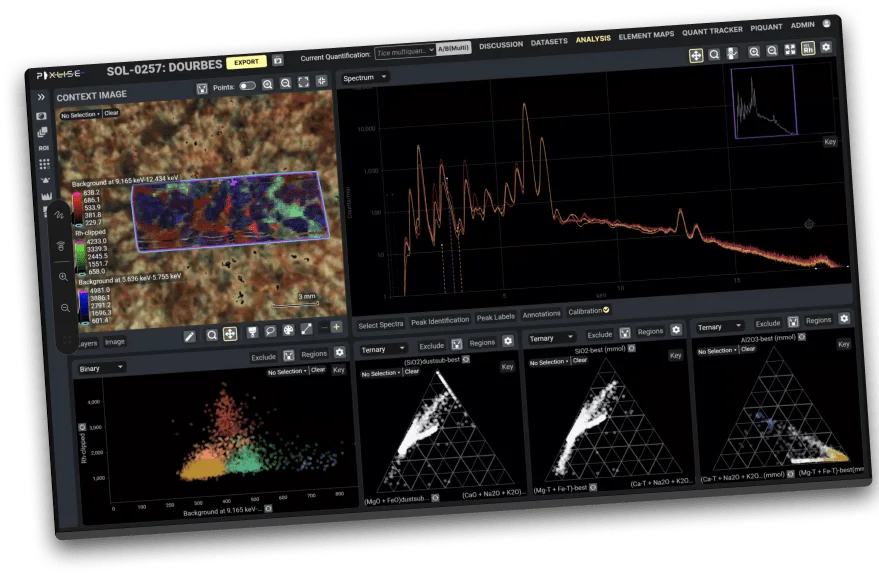
Concept to Cloud collaborated with NASA JPL on Pixlise, an open-source tool processing X-Ray spectrometry data for Mars Perseverance Rover research. Scientists needed real-time answers about rock composition, but existing Excel workflows required approximately 30 hours of processing per dataset.
The development team (distributed across LA, London, and Melbourne) prioritized researcher acceptance and platform simplicity. Performance improvements reduced processing to under 20 minutes. The platform evolved into a collaboration space where scientists shared datasets, views, analyses, and findings, eliminating the instinct to dump a CSV to the laptop.
Custom scripting capabilities allowed researchers to write formulas for unaddressed queries. The tool’s flexibility resulted in multiple paper citations, and subsequent open-source release enabled validation of computations and processes. Read the full Pixlise case study to learn more.
Asking Important Questions
Success depended on rigorous UX research investigating researcher pain points. End users often describe middle-ground solutions rather than comprehensive needs, planning offline completion later. Thoroughly investigating use cases and interaction patterns prevents building incomplete products.
Equally important: implementing valid feedback while avoiding time wastage on irrelevant suggestions maintains researcher engagement.
The Future of Cloud-based Research
Cloud-based Data Processing
Cloud processing infrastructure continues expanding across tooling, scale, and use cases. However, not every dataset requires cloud-scale architecture. Small projects might simply use EC2 servers connected to S3 buckets, while others benefit from Databricks’ pay-per-use compute model.
No universal solution exists, decisions emerge from organizational factors: existing cloud providers, available offerings, and experimentation with free tiers.
Custom UI and Interactions
Most projects don’t require custom interfaces, but some deserve investment when budget permits. Platforms like Superset, Quicksight, or PowerBI offer flexibility balancing custom graphics with managed application support.
Investing upfront time investigating researcher preferences regarding visualization and interaction patterns significantly impacts usability and adoption.
AI Considerations
Cloud infrastructure increasingly hosts model training and deployment for machine learning and LLMs. As models evolve and complexity increases, cloud resources enable advanced functionality development.
Frequently Asked Questions
Main cloud computing benefits for scientific research:
- Increased computational power for complex simulations
- Cost-effectiveness through pay-as-you-go pricing
- Scalability matching project needs
- Real-time collaboration among dispersed teams
- Remote accessibility via internet connection
Most useful cloud services:
- High-performance computing resources
- Data storage and management
- Virtual machines for specialized software
- Web hosting for sharing tools and results
Quality and quantity improvements:
- Enabling advanced analyses
- Increasing research output through parallel processing
- Facilitating reproducibility
- Speeding computations
Potential challenges:
- Data security and privacy concerns
- Cost management requiring usage monitoring
- Learning curves for new technologies
- Data transfer and bandwidth limitations
Getting started:
- Assess computational needs
- Explore research-focused platforms
- Begin with small-scale projects
- Consider expert consultation
Special considerations:
- Data sovereignty and storage locations
- Export control law compliance
- Budget incorporation into grant proposals
- Long-term data management planning
Conclusion
Cloud complexity creates short-term friction when departing from established practices, but enables substantial benefits. Nearly unlimited compute and storage serve most researcher needs. Modern technologies replicate local tools in hosted environments or enable custom builds.
Beyond infrastructure, cloud platforms facilitate sharing, collaboration, and rapid dataset access. Funding shapes the approach: smaller projects run on cheap object storage and VMs; larger ones justify custom application design.
Consider research longevity: single-project research differs from repeated studies. Scalable cloud architectures reduce future extraction and analysis costs. Open-sourcing code enables other researchers’ advancement, multiplying project value across future investigations.
Need help building a custom research platform? Contact our team to discuss your requirements, or explore our data-centric application design services.
Ex-NASA engineer and cloud architect with over a decade of experience building scalable systems for startups and enterprises.
Work with Tom →